

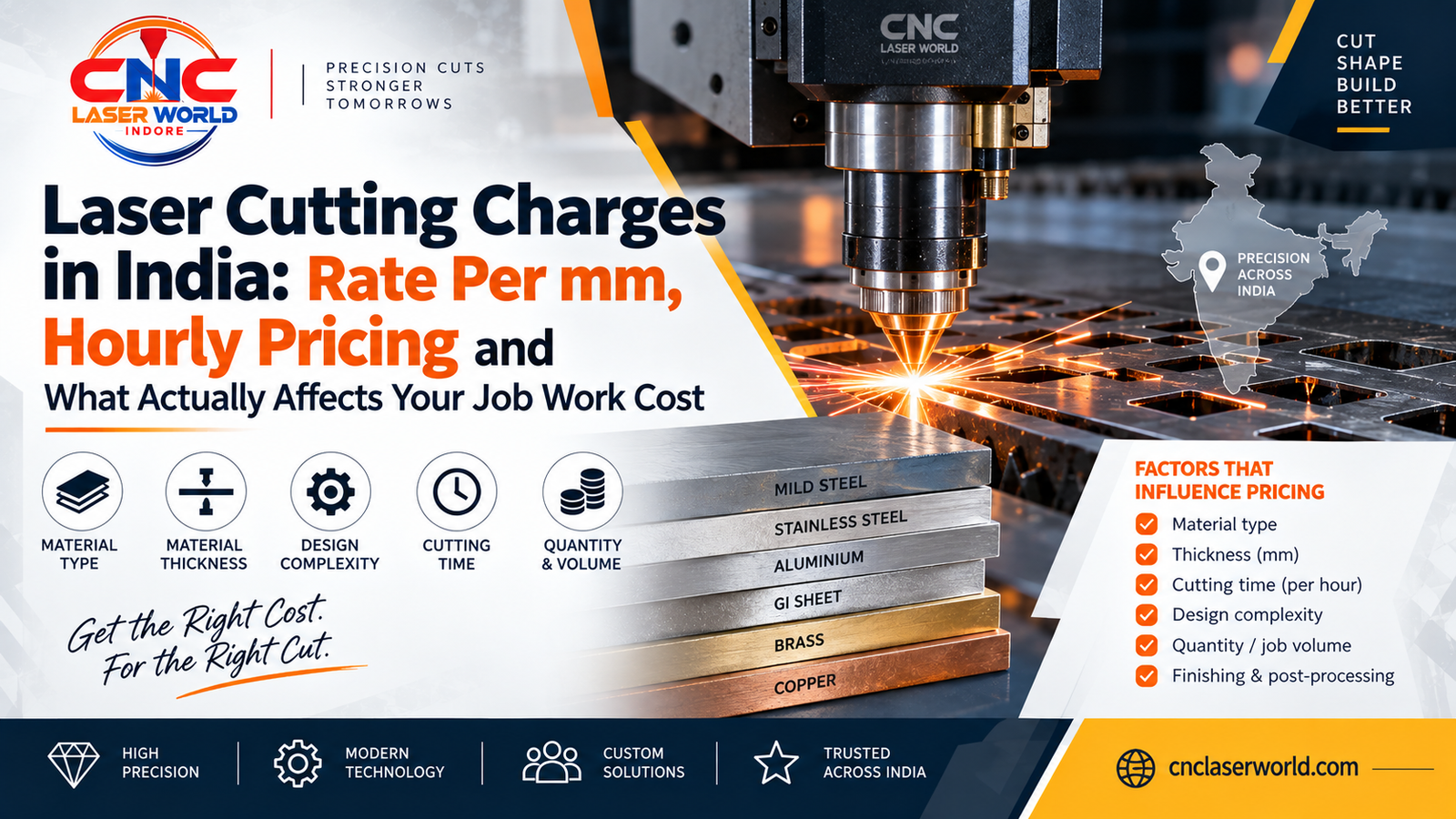
Laser Cutting Charges in India: Rate Per mm, Hourly Pricing and What Actually Affects Your Job Work Cost
Understanding the laser cutting rate per mm in India is important for manufacturers, fabricators and businesses that regularly outsource metal cutting work. However, there is no universal rate that applies to every laser cutting project. The final cost depends on several factors such as material type, thickness, cutting length, design complexity, machine capacity, order quantity and additional fabrication requirements. Knowing how these factors influence pricing can help you evaluate quotations more effectively and choose a cutting solution that offers the right balance of quality and cost.
How Are Laser Cutting Charges Calculated in India?
Laser cutting charges are usually calculated using one or more pricing methods. Depending on the service provider and the nature of the project, the quotation may be based on cutting length, machine operating time, material consumption or the complete job requirement.
For a typical CNC laser cutting project, the service provider may consider:
- Type and grade of material
- Material thickness
- Total cutting length
- Number of components
- Number of holes and internal cutouts
- Machine power and capability
- Cutting speed
- Programming and setup time
- Material wastage
- Order quantity
- Loading and handling
- Deburring or finishing
- Additional fabrication requirements
This is why two components with similar dimensions can have very different cutting costs. A simple rectangular component may require only a few straight cuts. A complex component with numerous holes and intricate contours can require considerably more machine movement and piercing operations.
A professional quotation should therefore be based on the complete job requirement rather than a single rate.
Laser Cutting Rate Per mm India: What Does It Include?
The laser cutting rate per mm in India is a common way of discussing cutting charges. In this pricing model, the total cutting length of a component is calculated from the programmed CNC toolpath.
For example, a component with a longer perimeter will generally require more cutting time than a smaller component. However, cutting length alone does not determine the final cost.
The rate can vary according to:
- Material type
- Thickness
- Laser power
- Cutting speed
- Number of piercings
- Complexity of the drawing
- Quantity
- Required tolerance
A design containing hundreds of small holes may have a relatively modest total cutting length but still take significant machine time because every hole requires controlled movement and often an individual piercing operation.
Some providers may also apply a minimum job charge. This is common for small orders because programming and machine setup still require time even when the quantity is low.
Therefore, the per-mm rate should be viewed as part of the pricing calculation rather than the full price of the job.
Fiber Laser Cutting Price Per Hour
Another pricing method is based on machine operating time. The fiber laser cutting price per hour can reflect the cost of running the machine during production.
The hourly operating cost may include several components such as:
- Electricity consumption
- Assist gases
- Laser source operation
- Machine maintenance
- Consumables
- Operator cost
- Programming
- Equipment depreciation
The actual processing time depends on the material and thickness, along with the complexity of the component.
A thin sheet with a simple profile may be processed quickly. A thicker plate containing multiple holes and detailed contours can require considerably more time.
Machine power is another important consideration. A higher-power fiber laser can process certain materials and thicknesses at faster speeds. However, the operating economics depend on the specific machine configuration and job requirement.
For this reason, comparing hourly rates without knowing the expected machine time can give an incomplete picture of the actual cost.
Material Type Directly Affects Laser Cutting Cost
Material is one of the most important factors in determining laser cutting charges.
Common materials processed through industrial laser systems include:
- Mild steel
- Stainless steel
- Aluminium
- Galvanized steel
- Other compatible metal grades
Different materials respond differently to laser energy. Cutting parameters such as power, speed, focus position and assist gas may need to be adjusted according to the material.
Material cost itself can also represent a significant portion of the project budget. If the customer supplies the sheet or plate, then the quotation may mainly cover processing. If the service provider supplies the material, then its cost will normally be included in the final quotation.
When requesting a price, it is important to specify the exact material grade whenever possible. Simply stating “steel” may not provide enough information for an accurate quotation.
How Material Thickness Changes the Price
Thickness has a direct relationship with laser cutting time and processing requirements.
As material thickness increases, the cutting speed may decrease while the required laser power and assist gas conditions can increase. This can result in higher processing costs.
For example, a 2 mm mild steel component and a 12 mm mild steel component may have the same design. Their cutting costs can still be significantly different because the machine parameters and processing time are not the same.
When requesting a quotation, always mention:
Material: Mild steel
Thickness: 6 mm
Quantity: 100 pieces
Drawing: DXF or DWG
Requirement: Cutting only
Providing these details gives the service provider a much better basis for calculating the job.
Design Complexity Can Increase Processing Time
The shape of your component can have a major impact on laser cutting costs.
A simple profile with long straight edges is generally easier to process than a component containing numerous small features.
Design elements that can influence processing time include:
- Small holes
- Multiple internal cutouts
- Tight contours
- Sharp corners
- Closely spaced features
- Detailed patterns
- Large numbers of piercing points
The quality of the CAD drawing also matters. Duplicate lines or incorrect geometry can create programming issues and may require additional preparation before production.
Providing a clean production-ready drawing can make the quotation process faster while reducing the possibility of manufacturing errors.
Quantity and Batch Size Influence the Final Cost
Order quantity is another important factor when calculating laser cutting charges.
For a one-off component, the cost of programming and machine setup may represent a relatively large portion of the total price. When the same component is produced in larger quantities, these setup costs can be distributed across more parts.
Larger orders can also allow better material nesting. Several components can be arranged on a single sheet to reduce unused material.
However, larger quantities do not automatically guarantee a lower price. The overall cost still depends on material value, component complexity and production requirements.
If you require recurring production, it is useful to discuss expected monthly or quarterly quantities with the cutting provider. This can help determine a more efficient production approach.
CNC Laser Cutting Job Work: What Information Should You Provide?
Businesses outsourcing CNC laser cutting job work can make the quotation process considerably easier by providing complete technical information.
A proper job work enquiry should ideally include:
- CAD drawing or production file
- Material grade
- Material thickness
- Required quantity
- Component dimensions
- Required tolerance
- Delivery requirement
- Finishing requirements
- Material supply responsibility
If your project contains multiple components, then provide a component list along with the individual quantities.
At CNC Laser World, the quotation process can be more accurate when the technical requirements are clearly defined before production planning begins. This helps ensure that the selected cutting process is suitable for the material and application.
CNC Fiber Laser Cutting Job Work
CNC fiber laser cutting job work is a practical option for businesses that need precision cutting without investing in their own laser cutting machinery.
Outsourcing can be useful when a company needs:
- Additional production capacity
- Prototype components
- Short production runs
- Regular outsourced manufacturing
- Complex metal profiles
- Specialized cutting capabilities
Fiber laser technology can provide repeatable CNC-controlled cutting for compatible materials. However, the machine should always be selected according to the material thickness and component dimensions.
When choosing a job work provider consider cutting accuracy and consistency alongside price. A slightly cheaper service can become expensive if poor cutting quality results in rework or additional finishing.
Sheet Metal Cutting Job Work India
The demand for sheet metal cutting job work in India continues to grow as manufacturers outsource specialized production processes.
Outsourcing allows companies to avoid the capital investment associated with purchasing and maintaining industrial laser equipment. It can also provide access to specialized machinery when production requirements change.
Sheet metal laser cutting is commonly used for:
- Electrical panels
- Machine enclosures
- Industrial cabinets
- Automotive components
- Engineering parts
- Equipment covers
- Metal furniture components
For repeated production work, consistency becomes especially important. Components should maintain the same dimensions and feature positions across batches so they can be assembled without unnecessary adjustment.
CNC Laser Cutting Price Enquiry: What Should You Ask?
A CNC laser cutting price enquiry should provide enough information for the service provider to understand the complete scope of work.
Instead of simply asking for a per-mm rate, ask whether the quotation includes:
- Material
- Programming
- Machine setup
- Cutting
- Handling
- Deburring
- Taxes
- Delivery
- Additional fabrication
It is also useful to ask about production lead time and minimum order charges.
This makes it easier to compare quotations because you are comparing the complete service rather than isolated pricing figures.
Get Laser Cutting Quote Online With the Right Information
If you want to get a laser cutting quote online, the easiest approach is to prepare your drawings and technical specifications before submitting the enquiry.
A quotation request should ideally contain your CAD file along with material type, thickness, quantity and required delivery timeline.
For multiple components, provide a complete list. If the material needs to be supplied by the service provider, mention this clearly.
You should also specify whether you require only cutting or additional processes such as bending, welding or assembly.
The more accurate the information provided at the enquiry stage, the more useful the quotation will be.
Request Fabrication Quote India for Complete Requirements
Some projects require much more than laser cutting. If your components need bending, welding or assembly, then you may need to request fabrication quote India services covering multiple production stages.
A fabrication requirement may include:
- CNC laser cutting
- Sheet bending
- Welding
- Drilling
- Grinding
- Deburring
- Surface preparation
- Assembly
Working with one provider for multiple processes can simplify vendor coordination and reduce unnecessary transportation between different workshops.
However, the quotation should clearly define every included process so that there are no surprises later.
Laser Cutting Job Work in Indore: What Should You Consider?
Businesses searching for laser cutting job work in Indore should evaluate service providers based on both technical capability and operational reliability.
Local sourcing can make communication and transportation easier. It can also be useful for manufacturers that need regular job work or quick production support.
However, proximity should not be the only selection factor. Consider:
- Machine power
- Maximum material size
- Material compatibility
- Cutting accuracy
- Production capacity
- Quality control
- Delivery reliability
- Fabrication capabilities
If you are searching for a laser cutting service near me, then comparing these factors can help you identify a provider that is actually suitable for your project.
Why the Lowest Laser Cutting Price Is Not Always the Best
It is natural to compare prices when outsourcing manufacturing work. However, the cheapest quotation may not always provide the lowest overall project cost.
A very low price may exclude material handling, deburring, programming or other services. Cutting quality can also affect the final cost.
For example, excessive dross may require additional grinding. Incorrect dimensions can create assembly problems. Poor nesting can increase material wastage.
A reliable laser cutting partner should provide a transparent quotation and clearly define what is included.
CNC Laser World focuses on understanding the technical requirements before determining the appropriate cutting approach. The goal is to deliver a practical balance between precision, production efficiency and cost.
How Can You Reduce Laser Cutting Costs?
You do not always need to compromise quality to reduce production expenses. Better planning can often make a noticeable difference.
Optimize Your Design
Remove unnecessary features where they do not contribute to the function of the component. Simplifying geometry can reduce cutting time.
Improve Material Utilization
Efficient nesting can reduce scrap and improve the number of usable components obtained from each sheet.
Consolidate Production
If the same components are required regularly, then combining suitable quantities into planned production batches can improve efficiency.
Provide Clean CAD Files
Accurate drawings reduce programming time and help prevent errors during production.
Select the Right Cutting Process
Not every component requires the same machine or cutting configuration. Matching the process to the material and application can improve overall project economics.
Conclusion
The cost of laser cutting in India cannot be determined accurately from a single per-mm figure. The laser cutting rate per mm in India can change according to material type, thickness, cutting length, design complexity, machine capacity and order quantity.
Hourly pricing also reflects factors such as machine operation, electricity, assist gases, consumables, maintenance and labour. For businesses outsourcing CNC laser cutting job work, providing accurate drawings and complete technical specifications is one of the simplest ways to receive a reliable quotation.
Whether you need CNC fiber laser cutting job work, sheet metal cutting or complete fabrication support, the right service provider should evaluate your project based on its actual manufacturing requirements.
CNC Laser World can support businesses looking for precision-oriented CNC laser cutting solutions by focusing on the specific requirements of each job. Rather than choosing a provider solely because it offers the lowest quoted rate, consider cutting quality, technical capability, material utilization, consistency and delivery performance. A transparent quotation combined with the right cutting process can ultimately deliver better value and more predictable manufacturing costs.