

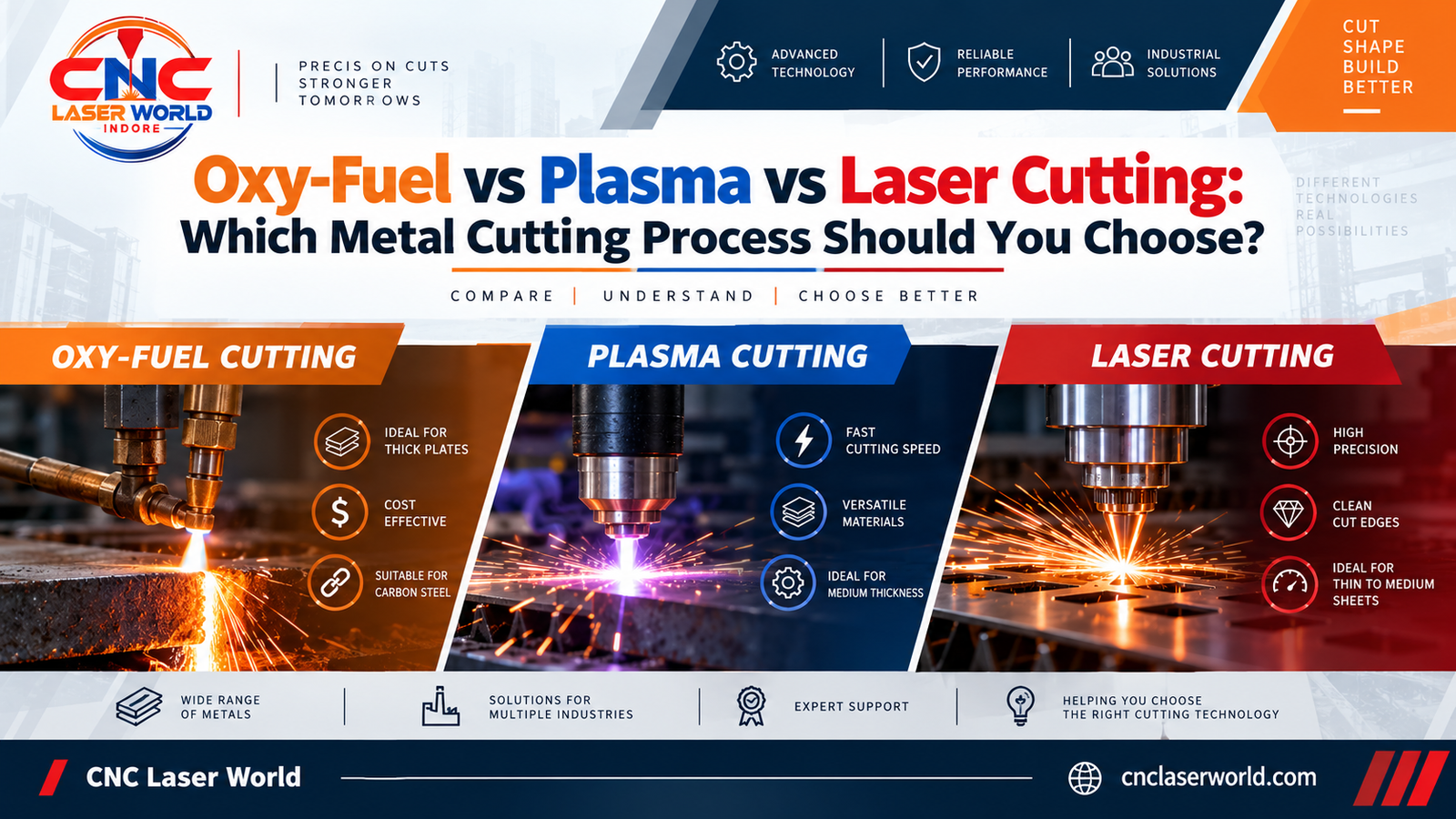
Oxy-Fuel vs Plasma vs Laser Cutting: Which Metal Cutting Process Should You Choose?
Choosing the right metal cutting method can directly affect production speed, edge quality, material utilization and overall fabrication costs. The oxy-fuel vs plasma cutting decision becomes even more important when you compare both processes with modern laser technology. Oxy-fuel cutting remains widely used for thick steel plates, while plasma offers a practical solution for conductive metals across various thicknesses. Laser cutting is known for its precision and repeatability. Understanding how these technologies work and where each performs best can help manufacturers choose the right process for their specific application.
What Is Oxy-Fuel Cutting?
So what is oxy-fuel cutting and why has it remained relevant in metal fabrication for decades?
Oxy-fuel cutting uses a fuel gas and oxygen to heat steel to its ignition temperature. A high-pressure stream of oxygen is then directed onto the heated area. The oxygen reacts with the steel and removes the resulting oxidized material from the cut zone.
Common fuel gases include acetylene, propane and other fuel gases depending on the equipment and application. The process is particularly suitable for carbon steel and is widely associated with structural fabrication and heavy plate processing.
Unlike laser cutting, which relies on a focused beam of light, oxy-fuel cutting is a thermal cutting process based on combustion and oxidation.
This makes it particularly useful for applications where very thick carbon steel needs to be separated and ultra-fine tolerances are not the primary requirement.
Oxy Fuel Cutting for Thick Steel
One of the biggest advantages of oxy-fuel cutting for thick steel is its ability to process heavy carbon steel plates. Oxy-fuel equipment can be configured for substantial plate thicknesses and is often selected for heavy fabrication work.
Typical applications include:
- Structural steel fabrication
- Heavy machinery manufacturing
- Shipbuilding
- Construction equipment
- Industrial plants
- Bridges and infrastructure
- Large steel assemblies
The process can also be comparatively economical for heavy plate work because the equipment and consumables can be well suited to large-scale cutting operations.
However, thicker material does not automatically mean oxy-fuel is the best option. The required dimensional tolerance, edge condition, heat-affected zone and production volume should also be considered.
For components where precision and intricate geometries are important, another cutting technology may provide better results.
What Is Plasma Cutting?
Plasma cutting uses an electrically conductive gas that is heated to extremely high temperatures to create plasma. The plasma arc melts the metal while a high-velocity gas stream removes the molten material from the cut.
Because the process relies on an electrical arc, plasma cutting is suitable for electrically conductive metals such as mild steel, stainless steel and aluminium.
Plasma systems are available in different configurations and power levels. Modern CNC plasma machines can follow programmed cutting paths and produce components with repeatable dimensions.
Plasma is often positioned between oxy-fuel and laser cutting in terms of cutting speed, precision and material capability.
Plasma Cutting vs Oxy-Fuel Cutting
When comparing plasma cutting with oxy-fuel technology, there is no single process that is better for every application.
Oxy-fuel is particularly effective for thick carbon steel. Plasma offers greater versatility across conductive metals and can generally cut thinner materials faster than oxy-fuel.
The key differences include:
| Factor | Oxy-Fuel | Plasma |
| Cutting principle | Combustion and oxidation | Plasma arc |
| Suitable materials | Primarily carbon steel | Conductive metals |
| Thick carbon steel | Excellent | Very good |
| Stainless steel | Not generally suitable | Suitable |
| Aluminium | Not generally suitable | Suitable |
| Thin material | Limited | Better suited |
| Heat input | Relatively high | Moderate to high |
| Edge precision | Moderate | Better than oxy-fuel |
| Complex profiles | Possible | Suitable for many applications |
The final choice should be based on the material grade, thickness, geometry and required tolerance rather than simply selecting the technology with the highest advertised capacity.
Oxyfuel Cutting Service
A professional oxyfuel cutting service is often selected when projects involve heavy carbon steel plates or large structural components.
For heavy fabrication applications, the process can provide a practical combination of equipment flexibility and cutting capability. Large plates can be processed into basic shapes, structural components and industrial parts.
However, proper setup is essential. Torch alignment, oxygen pressure, fuel selection, cutting speed and material condition all influence the final result.
Operators also need to account for the heat generated during cutting. Thermal distortion can become more significant as material thickness and cut length increase.
This is why professional process planning is important when working with heavy plates.
Flame Cutting Service India
A flame cutting service in India is commonly associated with heavy engineering and structural steel applications where large or thick carbon steel components need to be cut.
Flame cutting can be useful for applications such as:
- Heavy structural components
- Base plates
- Machine foundations
- Industrial frames
- Large brackets
- Construction machinery
- Steel fabrication projects
For businesses outsourcing cutting work, it is important to provide accurate material specifications and drawings. Plate grade, thickness, dimensions and required tolerances can influence the most appropriate cutting method.
Gas Cutting Service for Thick Plates
A gas cutting service for thick plates can be a practical choice when the project involves heavy carbon steel and relatively straightforward geometries.
The process is capable of handling substantial thicknesses but typically creates a larger heat-affected zone compared with precision laser cutting.
Gas cutting may therefore be appropriate for structural or heavy engineering components where the primary objective is reliable material separation rather than extremely tight dimensional tolerances.
Secondary processes such as grinding, machining or edge preparation may sometimes be required depending on the component’s final specification.
Heavy Plate Cutting Service
A heavy plate cutting service needs to consider more than the nominal thickness of the steel. Material grade, plate size, geometry and tolerance requirements all affect cutting performance.
Heavy plate applications often involve significant material handling requirements. The cutting equipment must be capable of safely positioning and processing large workpieces while maintaining the required cutting path.
For industrial projects, production planning can also influence the final cost. Efficient nesting can reduce scrap, while selecting the correct cutting process can reduce secondary operations.
For example, a component with simple straight cuts may be efficiently processed using flame cutting, while a complex component requiring numerous holes and intricate contours may benefit from plasma or laser technology.
How Does Laser Cutting Compare?
Laser cutting uses a highly focused beam of light to melt or vaporize material within a narrow cutting zone. Assist gases are used to remove molten material and support the cutting process.
Modern CNC laser systems are capable of producing highly accurate components with narrow kerfs and relatively clean edges.
Laser technology is especially valuable when a project requires:
- Tight dimensional tolerances
- Complex geometries
- Small holes
- Detailed profiles
- Repeatable production
- Reduced secondary finishing
- Efficient sheet and plate processing
Fiber laser systems have become increasingly important in industrial metal processing because of their efficiency and ability to process several commonly used metals.
Thick Plate Laser Cutting India
The demand for thick plate laser cutting in India has grown as high-power laser systems have become more capable of processing thicker materials.
However, laser cutting performance at greater thicknesses depends heavily on laser power, material type, plate condition, assist gas, machine configuration and cutting parameters.
Laser cutting can provide advantages when a thick plate component requires a combination of detailed geometry and accurate dimensions. Features such as holes, slots and contours can often be incorporated directly into the CNC cutting program.
This can reduce the need for separate drilling or mechanical cutting operations.
At the same time, laser cutting should not automatically replace oxy-fuel or plasma. For extremely thick carbon steel where precision requirements are moderate, conventional thermal cutting may still be the more practical solution.
Thick Steel Plate Cutting Services: Which Process Works Best?
Businesses looking for thick steel plate cutting services should evaluate the application before choosing a technology.
A simple decision framework can help:
Choose oxy-fuel when:
The material is thick carbon steel and the component has relatively straightforward geometry. Cost-effective heavy plate separation is a major priority.
Choose plasma when:
The material is electrically conductive and the project requires faster cutting across a broader range of metals and thicknesses.
Choose laser when:
The component requires higher precision, complex profiles, smaller features or consistent repeatability.
There can also be situations where more than one process makes sense within the same project. Heavy plates may be rough cut using one technology and then machined or finished according to the required specification.
CNC Laser Cutting Services for Precision Applications
CNC laser cutting services are particularly useful when manufacturing requires repeatability and detailed component geometry.
The CNC system uses digital drawings to control the movement of the cutting head. This makes it possible to reproduce the same component multiple times with consistent cutting paths.
For manufacturers and fabricators, this can be valuable when producing batches of components where dimensional variation could affect assembly.
At CNC Laser World, selecting a cutting process should begin with understanding the actual manufacturing requirement. Material grade, thickness, component dimensions, tolerance, geometry and quantity all play a role in determining the right approach.
The objective is not simply to use the most advanced machine available. It is to match the technology to the job so that the finished component meets its intended specification efficiently.
Oxy-Fuel vs Plasma vs Laser: A Practical Comparison
| Factor | Oxy-Fuel | Plasma | Laser |
| Best suited for | Thick carbon steel | Conductive metals | Precision metal components |
| Material versatility | Limited | High | High |
| Thick plate capability | Excellent | Very good | Depends on system |
| Cutting precision | Moderate | Good | Excellent |
| Complex shapes | Moderate | Good | Excellent |
| Small holes and details | Limited | Moderate | Excellent |
| Heat-affected zone | Higher | Moderate | Narrower |
| Initial equipment complexity | Lower | Moderate | Higher |
| Production repeatability | Good with CNC | Very good with CNC | Excellent with CNC |
This comparison shows why the right technology depends on the application. A heavy structural plate and a precision machine component may require completely different cutting approaches even when both are made from steel.
How to Choose the Right Metal Cutting Process?
Before placing an order with a cutting service provider, consider these practical questions:
What material are you cutting?
Carbon steel can be processed using oxy-fuel, while stainless steel and aluminium generally require processes such as plasma or laser.
How thick is the material?
Thickness is one of the most important factors in process selection. Verify the practical cutting range rather than relying only on theoretical machine capacity.
How precise does the component need to be?
Tight tolerances and detailed geometries generally favor laser cutting.
How complex is the profile?
Intricate designs with multiple holes and slots can benefit from CNC-controlled laser or plasma cutting.
What quantity is required?
For repeated production, process repeatability and nesting efficiency can have a significant effect on overall manufacturing cost.
Is additional fabrication required?
If components also require bending, welding, machining or finishing, selecting a provider that understands the complete fabrication workflow can simplify production.
Conclusion
The oxy-fuel vs plasma cutting comparison does not have a universal winner. Oxy-fuel remains a strong option for thick carbon steel and heavy fabrication. Plasma provides versatility for conductive metals and can deliver efficient cutting across a broad range of applications. Laser cutting stands out when precision, complex geometry and repeatability are critical.
For projects involving heavy plate cutting service, thick steel plate cutting or precision components, the best approach is to evaluate material, thickness, tolerance, geometry and production requirements together.
CNC Laser World can help manufacturers and fabricators identify suitable CNC-based cutting solutions based on the actual requirements of their components. The right technology is not always the newest one. It is the process that delivers the required quality, productivity and consistency for the job.